By


Telecommunication trends are often closely aligned with advancements in technology. With so much disruption coming from AI, there are so many opportunities that have arisen for the communication industry to accelerate growth.
This rapid growth often comes with new challenges. Customer behaviors are advancing to new levels of personalization, which comes from these new technologies. Economic, competitive and political factors have also driven Telcos to strategically simplify their portfolio, product catalogues, and products and spearhead transformation leveraging the prowess of data and AI. Telco companies that want to get ahead of the AI boom will need to optimize product offers, ease of ordering, ease to change, customer service, multiple channel presence, and regional data protection laws.
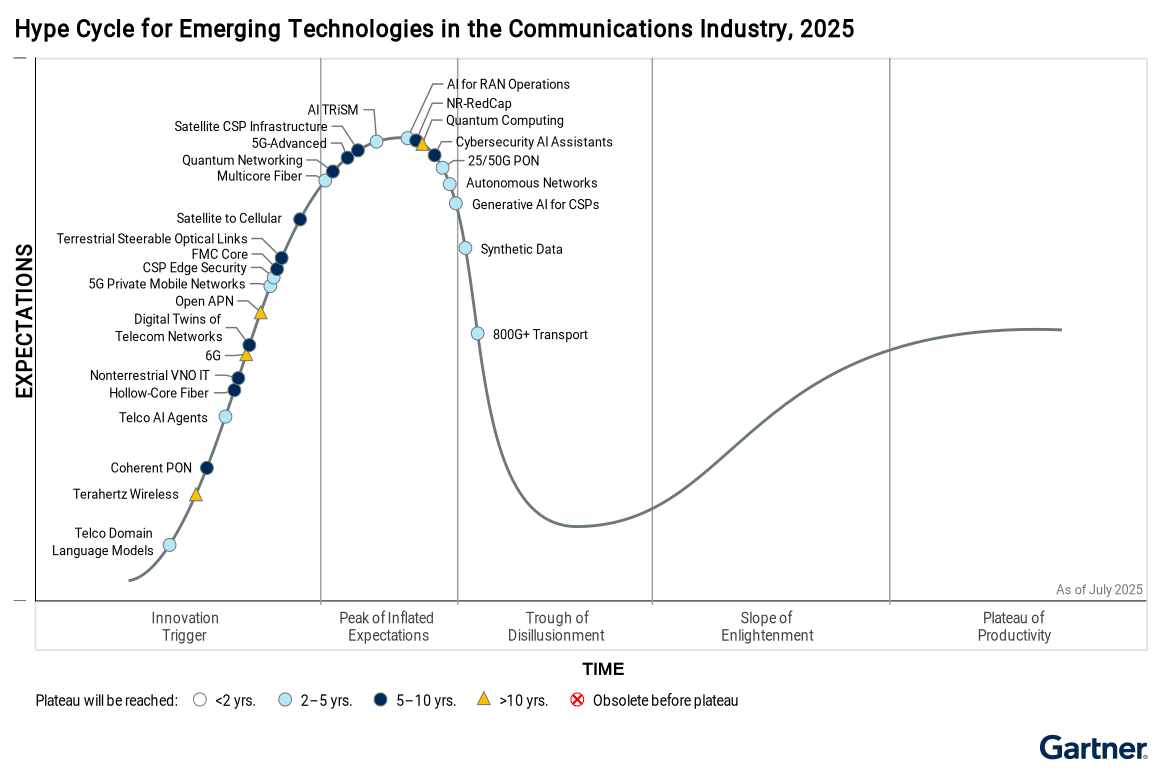
A helpful resource to navigate these telecommunication trends comes from the Communications Industry Gartner Hype Cycle for emerging technologies. Network Engineers, Product Owners and Telco managers need to be prepared for what is coming into the horizon over the next few years.
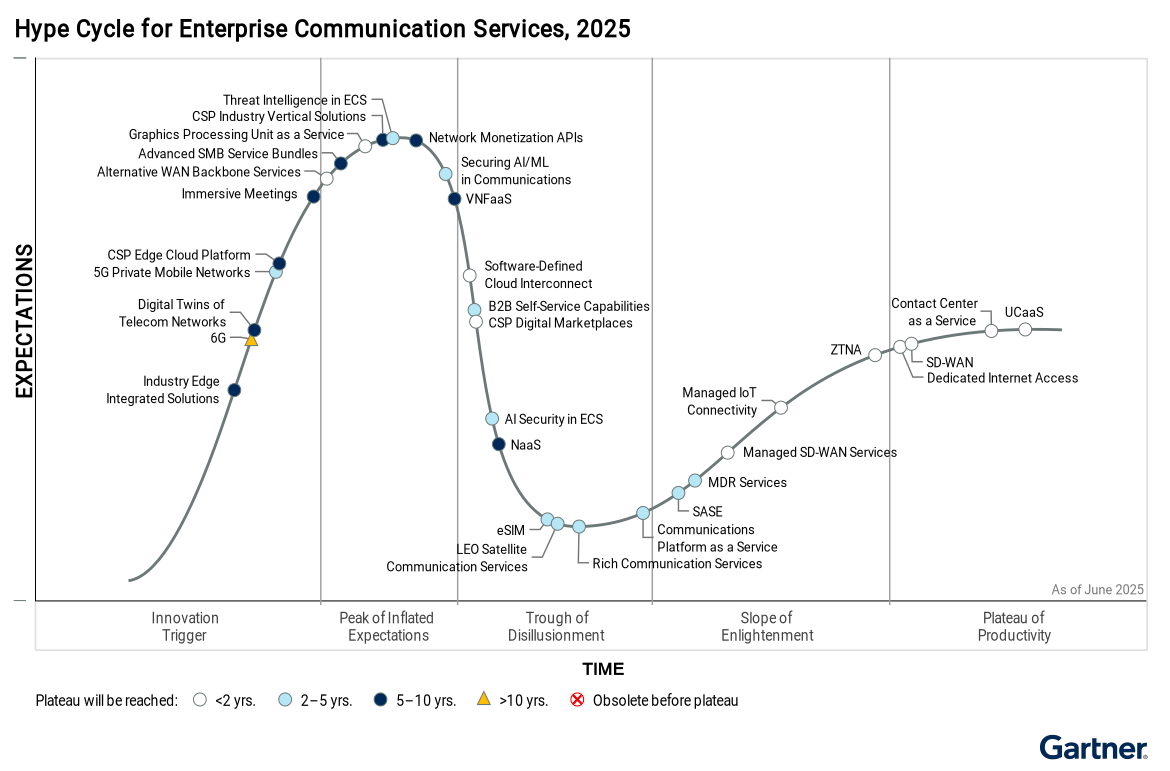
The hype cycle for communication services show relative maturity and adoption in UCaaS, SD-WAN automated services in various guises with NaaS coming up in the horizon
TELUS Digital and our Enterprise Technologies Practice (including Salesforce) has extensive experience in navigating this labyrinth from the Network layer to the BSS and Customer Engagement layers.
Related Article: Creating an agentic enterprise around the CRM
Top 10 telecommunication trends in 2026
1. Agentic AI becomes core to telecom operations
AI agents move from experimentation to production, enabling real time, AI-powered decision-making across telecom networks. Network operators increasingly rely on AI-driven automation to scale operations and protect long-term return on investment.
2. AI-Driven network management at scale
Network management evolves through AI-powered analytics that dynamically optimize data traffic, predict failures, and self-heal network infrastructures. This shift is critical as mobile networks grow more complex and usage intensifies.
3. Customer experience becomes a competitive battleground
Telecom companies prioritize personalization across every channel. Superior customer experience is now directly tied to churn reduction, brand equity, and measurable ROI.
4. Portfolio simplification enables new business models
Legacy complexity constrains growth. Telcos that rationalize product catalogs and modernize digital infrastructure unlock more agile, scalable business models that support faster innovation and long term value creation.
5. Network-as-a-Service moves toward commercial reality
As network infrastructures become programmable, network operators introduce consumption-based offerings across telecom networks. This transition reshapes how enterprises buy, consume, and scale connectivity services.
6. Radio access network transformation accelerates
The radio access network becomes a focal point for AI optimization, supporting higher data traffic volumes, improved latency, and more efficient spectrum utilization across next-generation mobile networks.
7. Earth Orbit LEO expands global connectivity
Earth orbit LEO deployments extend coverage beyond traditional boundaries, reshaping telecom networks by enabling resilient connectivity for remote regions, smart cities, and critical digital infrastructure.
8. Smart cities drive demand for intelligent networks
Smart cities depend on telecom networks to support autonomous systems, public services, and urban data platforms—placing new performance and reliability demands on network operators.
9. Quantum computing enters strategic planning horizons
While still emerging, quantum computing begins influencing long-term telecom strategy, particularly in encryption, network optimization, and complex traffic modeling for future network infrastructures.
10. Digital infrastructure becomes a board-level priority
By 2026, digital infrastructure is no longer an IT concern but a strategic asset. Telecom companies that align AI, data, and network modernization directly to business outcomes will outperform peers on growth, resilience, and return on investment.
Related Article: How Agentforce will redefine enterprise execution
Value realization comes from tech debt reduction, streamlining portfolio taxonomies, structures and processes. We pursue this with our Portfolio Managers, Product Managers, Architects, and Designers at the forefront of transformation in the telecom sector.
Partner with TELUS Digital
TELUS Digital has key platinum-type partner relationships across Salesforce, the Hyperscalers, Zendesk, ServiceNow, and more. This and our deep industry understanding from the Network layer upwards to the Engagement layer, allows the team to engage with global customers and bring in value across the whole spectrum of work in a telco organization.
The complexity of Telco business operations emerges as a significant barrier to digital transformation. The product portfolios, catalogues, and product structures lack strategic alignment and consistency, resulting in several challenges:
- Cluttered Product Taxonomies
- Rigid Product Architectures
- Disjointed Systems
We understand these challenges and want to help you navigate your digital transformation. Reach out to our experts today to see how AI can take your organization to the next level.